California Title 24 kitchen lighting requirements say that at least half of the wattage in your kitchen must come from high efficacy lighting. This rule applies to new kitchens, additions, and most kitchen remodels across the state. Homeowners and contractors often ask about this rule late in a project, right when fixtures are already picked out and ready to install. Understanding Title 24 kitchen lighting rules early saves you money, time, and a smooth final inspection. This guide covers the wattage rule, the lighting types that qualify, the exceptions, and the exact steps to get your kitchen approved the first time.
Under California Title 24 kitchen lighting rules, at least 50 percent of installed wattage must come from high efficacy lighting, such as JA8 certified LEDs. The remaining wattage can use standard bulbs, but it must switch on a separate circuit. This rule applies to new construction, additions, and most kitchen remodels statewide.
What Are California’s Title 24 Kitchen Lighting Requirements?
Title 24 is the section of California’s Code of Regulations that governs energy use in buildings. Part 6 of Title 24 covers lighting, and it sets the rules for how much energy a kitchen’s lighting system can use. The California Energy Commission created and updates these standards to cut wasted electricity across the state.
For kitchens specifically, the rule is simple on the surface. Half of the total lighting wattage in the room must come from high efficacy sources. The other half can use standard bulbs, as long as those bulbs sit on their own switch.
This rule does not only apply to brand new homes. It also applies to additions and most alterations, including kitchen remodels that change the lighting layout. Swapping out your old fixtures for a new design usually places your project under these Title 24 kitchen lighting rules.
What Counts as High Efficacy Lighting Under Title 24?
High efficacy lighting means fixtures that produce a lot of light while using very little power. Today, that almost always means LED. Older versions of the code allowed fluorescent lighting to qualify too, but LED has become the standard choice for new installs.
The Lumens Per Watt Table
Title 24 sets a minimum output for lighting to count as high efficacy. Fixtures rated at 15 watts or less need at least 40 lumens per watt. Fixtures between 15 and 40 watts need at least 50 lumens per watt. Anything above 40 watts needs at least 60 lumens per watt. Most modern LED products clear these numbers easily, so this rule rarely limits your design choices.
JA8 Certification Explained
JA8 stands for Joint Appendix 8, a section of the Title 24 code that sets quality standards for LED light sources used in homes. A fixture or bulb marked as JA8 compliant meets these standards and can count toward your high efficacy wattage. Screw base bulbs need a JA8 marked lamp installed at the time of inspection to qualify. Recessed downlights and other enclosed fixtures need JA8 certified light sources built in.
CRI and Color Temperature Requirements
JA8 also sets rules for how light looks, not just how much energy it uses. Qualifying lights need a color rendering index, known as CRI, of at least 90. This number measures how accurately a light source shows true colors. JA8 also limits color temperature to a range that stays close to natural indoor light, generally between 2700K and 4000K. This range keeps kitchens bright and clear without a harsh or overly blue tone.
The 50 Percent Rule, Explained With a Real Example
Numbers make this rule much easier to picture. Say your kitchen design includes eight recessed LED downlights at 10 watts each, plus two pendant lights at 40 watts each over the island. The recessed lights total 80 watts of high efficacy lighting. The pendants total 80 watts as well.
In this case, your kitchen sits at exactly 50 percent high efficacy wattage, which meets the minimum. Adding a third pendant would push the low efficacy share above 50 percent, and the design would no longer meet the standard. A quick check like this, done before you order fixtures, saves a redesign later in the project.
Recessed Lighting Rules for Kitchens
Recessed lighting is one of the most common choices in modern kitchens, and Title 24 sets specific rules for it.
No Screw Base Sockets, GU24 Requirement
New recessed downlights cannot use standard screw base sockets, also known as E26 sockets. Instead, they need a GU24 base or a light source that is permanently built into the fixture. This rule keeps future homeowners from swapping in a low efficacy bulb down the road.
Airtight and Insulation Contact Requirements
Recessed cans installed in insulated ceilings must carry an ICAT rating, which stands for insulation contact and airtight. This keeps conditioned air sealed off from the space around the fixture. A proper gasket or caulk seal between the housing and the ceiling meets this standard.
Under Cabinet and In Cabinet Lighting Rules
Under cabinet lighting has its own set of rules under Title 24. This lighting must switch separately from the main ceiling lights in the kitchen. That way, a homeowner can run task lighting over the counter without turning on every light in the room.
There is also a wattage cap for lighting installed inside cabinets, set at 20 watts per linear foot of illuminated cabinet space. Lighting placed fully inside a cabinet, such as inside a glass front display cabinet, may be excluded from the main wattage calculation depending on how it is installed. Confirm this detail with your local building department, since interpretation can vary slightly by jurisdiction.
Do Kitchen Islands, Peninsulas, and Pendant Lights Have to Comply?
Pendant lights over an island are a common design feature, and they raise a real question. Do these decorative fixtures need to be high efficacy too?
The answer depends on the overall math for the room. As long as your kitchen’s total wattage still clears the 50 percent high efficacy threshold, a few lower efficacy decorative pendants are allowed. The recessed lighting and under cabinet strips usually carry the bulk of the wattage, which leaves room for a decorative choice over the island.
Peninsulas and open nook areas create a trickier question. A peninsula with a sink and counter seating often still counts as part of the kitchen for compliance purposes. A fully separate breakfast nook, walled off or clearly distinct from the cooking area, may sometimes be treated differently. This distinction is not always spelled out clearly in the code itself, so it often comes down to how your local building inspector reads the layout. Confirm the interpretation with your local building department when a design sits close to this line.
Are Vacancy Sensors or Dimmers Required in Kitchens?
Kitchens do not carry the same vacancy sensor rule that applies to bathrooms, garages, and laundry rooms. Those rooms need lights on a vacancy sensor, which turns lighting off automatically when no one is present. Kitchens instead focus on the wattage split and on manual lighting controls, such as dimmers or separate switches for each lighting zone.
Modern Title 24 code expects kitchens to have separate, manual control for different lighting zones, such as general lighting, task lighting, and decorative lighting. This gives homeowners control over energy use without requiring automatic shutoff sensors in the room.
What Kitchen Lighting Is Exempt From Title 24?
A few lighting types fall outside the standard wattage calculation. Lighting built into kitchen appliances by the manufacturer, such as the light inside an oven, a range hood, or a refrigerator, does not count toward your kitchen’s wattage total. This exemption exists because these lights are part of the appliance itself, not part of the room’s fixed lighting system. If you are planning new appliances alongside your lighting layout, our kitchen appliance installation service confirms electrical and ventilation needs together so nothing gets missed.
Small, low wattage lights used in drawers or cabinets that use 5 watts or less and produce no more than 150 lumens also carry lighter requirements, since their energy impact stays minimal.
Does a Kitchen Remodel Always Trigger Title 24 Compliance?
Most kitchen remodels do trigger Title 24 kitchen lighting compliance, especially when the project changes the lighting layout or adds new permanently installed fixtures. A full kitchen renovation with a new lighting design almost always needs to meet current Title 24 standards.
A smaller project, such as swapping a bulb in an existing fixture without touching the wiring or layout, generally skips a full review. The line between a minor swap and a triggering alteration depends on the scope of work and your local permitting office. Pulling a permit for any electrical work gives you the clearest answer for your specific project.
How to Know If Your Kitchen Lighting Plan Will Pass Inspection
A few habits go a long way toward a smooth final inspection. Start by listing every fixture in your kitchen lighting plan, along with its wattage and whether it qualifies as high efficacy. Add up the high efficacy wattage and compare it against the total. This single check catches most compliance issues before installation day.
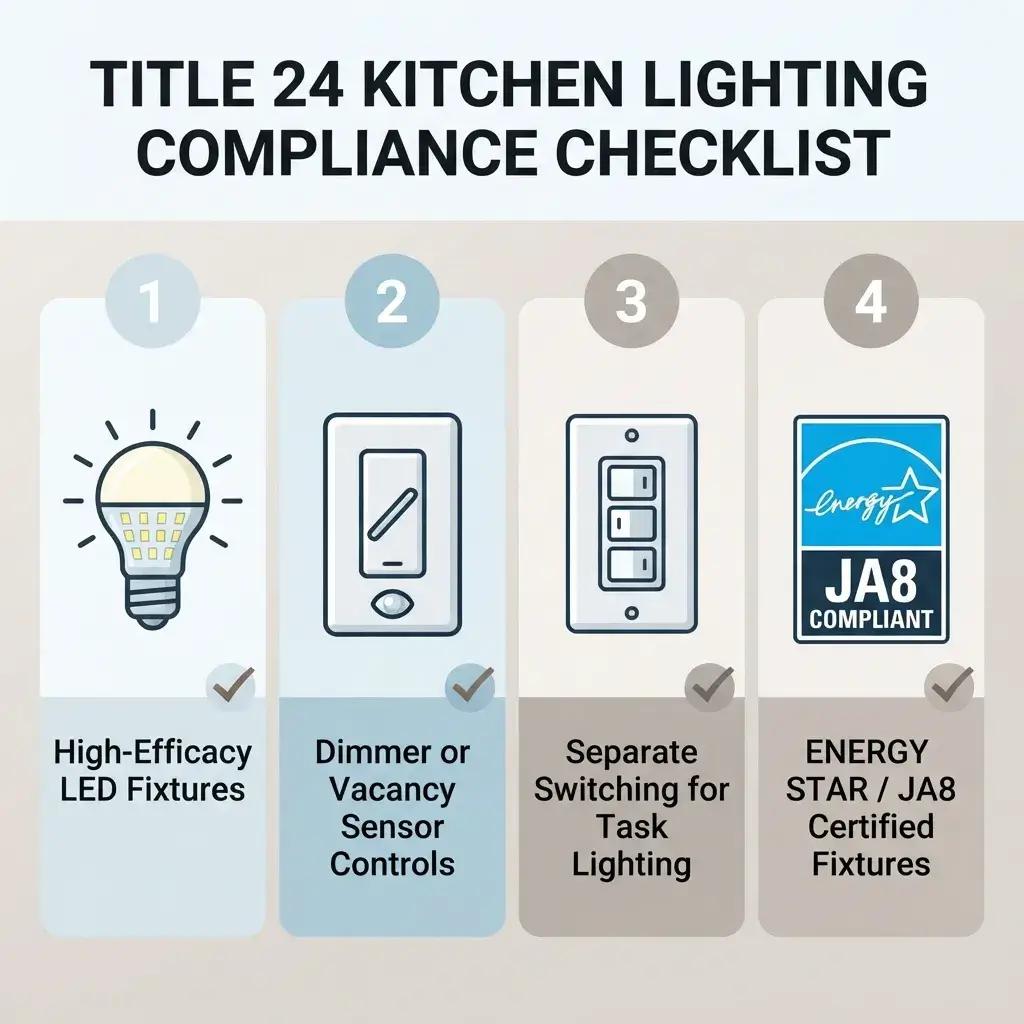
Next, confirm that your recessed lighting uses GU24 bases or permanently installed JA8 sources, not standard screw sockets. Check that under cabinet lighting sits on its own switch, separate from ceiling lighting. Keep your compliance documentation and any required forms on hand, since inspectors often ask for this paperwork during the visit. A kitchen design consultation before installation is one of the simplest ways to confirm your lighting plan meets these numbers ahead of time.
A short checklist to review before your inspection looks like this:
- Confirm total kitchen wattage and the high efficacy share
- Verify JA8 certification on recessed and enclosed fixtures
- Confirm GU24 bases on new recessed downlights
- Confirm separate switching for under cabinet lighting
- Keep compliance paperwork ready for the inspector
California Title 24 Kitchen Lighting FAQ
Do pendant lights over a kitchen island have to be high efficacy?
Not always. As long as the kitchen’s total wattage still clears the 50 percent high efficacy threshold, a few decorative pendants can use standard bulbs.
Can I use plug in or portable under cabinet lights to avoid Title 24 rules?
Plug in lighting that counts as portable, rather than permanently installed, generally falls outside the standard wattage calculation. Permanently wired under cabinet lighting counts and must meet the same rules as other fixed kitchen lighting.
Does replacing just one kitchen light fixture trigger Title 24 compliance?
A small, isolated fixture swap without new wiring or layout changes often skips a full compliance review. A broader remodel of the lighting plan usually triggers one. Confirm the scope with your local permitting office.
Do kitchen lights need a vacancy sensor or dimmer?
Kitchens skip the vacancy sensor rule that applies to bathrooms and garages. Kitchens instead focus on the wattage split and on separate manual switching for different lighting zones.
Is it 50 percent or 100 percent of kitchen wattage that must be high efficacy?
The statewide Title 24 standard sets the requirement at 50 percent. Confirm any claim of a stricter local rule directly with your city or county building department, since some jurisdictions add local requirements on top of the state minimum.
What does JA8 compliant mean for recessed lights?
It means the light source built into the fixture meets California’s quality and efficiency standards for LED lighting, including minimum CRI and a set color temperature range.
Can incandescent bulbs be used anywhere in a Title 24 kitchen?
Standard incandescent bulbs can cover up to half of the kitchen’s total lighting wattage, as long as they sit on a separate switch from the high efficacy lighting.
Are cabinet lights or a breakfast nook counted in the wattage calculation?
Lighting installed fully inside cabinets may be excluded from the main calculation, depending on installation. Breakfast nook treatment depends on whether the space reads as part of the kitchen or as a separate room, which your local inspector will determine.
How many recessed lights do I need for Title 24 compliance in a kitchen?
There is no fixed number. Compliance depends on total wattage and the share that comes from high efficacy sources, not the count of individual fixtures.
What happens if my kitchen lighting does not pass Title 24 inspection?
The inspector issues a correction notice listing the specific items to address. You then update the fixtures or switch to meet the standard, and the project moves forward from there.
Key Takeaways
California Title 24 kitchen lighting requirements center on one core number, the 50 percent high efficacy rule. Beyond that number, success comes down to a few clear details. Use JA8 certified sources in recessed and enclosed fixtures. Choose GU24 bases over screw sockets for new downlights. Keep under cabinet lighting on its own switch. Confirm your total wattage math before you install a single fixture. A little planning at the start of your kitchen project keeps your final inspection simple and your lighting design exactly the way you pictured it.