The real difference between custom vs semi custom cabinets is how they get built, not how good they are. Semi custom cabinets come from a factory catalog with choices you pick from. Custom cabinets get built from scratch to your drawings. Both can be excellent. Both can be plain. The label on the box tells you about the production method, and almost nothing about the plywood inside it.
That matters because most guides on custom vs semi custom cabinets treat these as three neat quality steps. Real showrooms work differently. One brand’s semi custom line will adjust cabinet depth by the inch and mix any paint color you bring in. Another brand’s semi custom line offers five door styles and zero size changes. Same tier name. Very different kitchen.
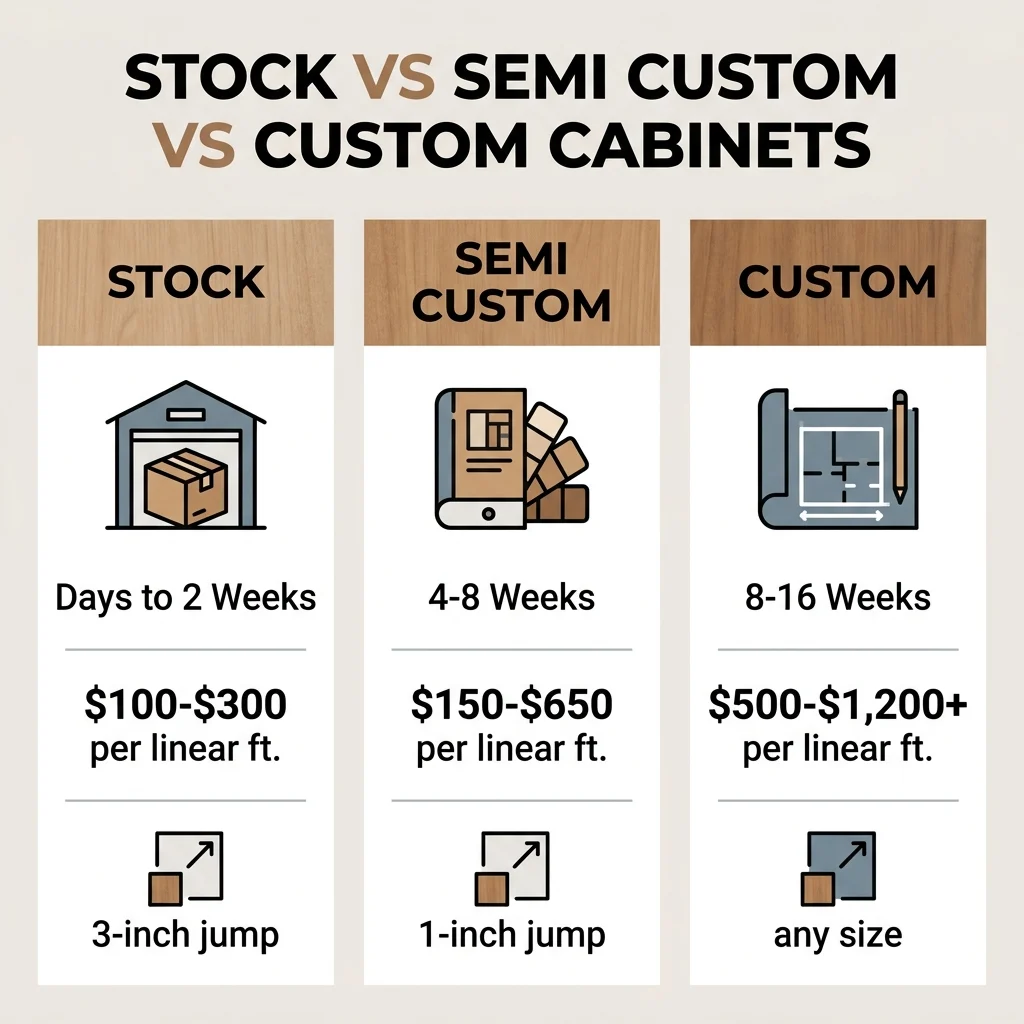
Stock cabinets ship pre assembled in fixed sizes and arrive fast. Semi custom cabinets get built to order from a set catalog of sizes, doors and finishes, usually in about four to eight weeks. Custom cabinets get built to your exact dimensions with any species, color or interior you want, usually in eight to sixteen weeks and at the highest price.
Comparison chart: stock, semi custom and custom
| Stock | Semi custom | Custom | |
| How it’s made | Built ahead, sits in a warehouse | Built to order from a catalog | Built to order from your drawings |
| Size steps | 3 inch jumps | 3 inch jumps, often 1 inch or less on better lines | Any size |
| Door and finish choices | A handful | Dozens, varies widely by brand | Open |
| Modifications | Rare | Depth, height and interior changes on many lines | Standard practice |
| Typical installed cost per linear foot | $100 to $300 | $150 to $650 | $500 to $1,200 |
| Lead time | Days to two weeks | Four to eight weeks | Eight to sixteen weeks |
| Filler strips needed | Often | Sometimes | Rarely |
| Best fit | Rentals, flips, square rooms | Most family kitchens | Old houses, odd walls, tall ceilings |
Cost ranges for stock and semi custom come from HomeAdvisor’s cabinet cost data. Custom pricing reflects what independent cabinet shops commonly quote, and it climbs fast with species and finish choices.
What each cabinet tier really means
Stock cabinets
Factories build these in high volume before anyone orders them. Sizes step up in 3 inch jumps, so a 34 inch gap gets a 33 inch cabinet plus a filler strip. Boxes usually use particleboard with a laminate skin. Delivery takes days. For a rental unit or a square galley kitchen, stock does the job well.
RTA and flat pack cabinets
RTA stands for ready to assemble. The parts ship flat and you screw the boxes together, which cuts shipping costs a lot. IKEA built its kitchen business on this format. Worth knowing: RTA describes packaging, not quality. Some RTA lines use plywood boxes and dovetail drawers. Some stock cabinets ship fully built and use cheaper materials. Judge the spec sheet, not the carton.
Semi custom cabinets
Nothing gets built until you order. You pick from a catalog: door style, wood species, finish, box material, interior fittings. Many lines also allow real changes, like reducing a base cabinet depth from 24 inches to 21 inches for a tight walkway. Kraftmaid, Merillat and Diamond all sell at this tier, and their option lists differ.
Custom cabinets
A shop measures your room, draws every box, then builds to those numbers. Want a 41.5 inch sink base with a 4 inch toe kick and a walnut interior? Done. You also pay for design time, shop drawings and hand finishing, which is where much of the price sits.
The one thing to know about custom vs semi custom cabinets
Semi custom is the loosest label in the industry. No standard body defines it. A manufacturer can print it on a brochure for a line with 40 finishes and inch by inch sizing, or for a line barely above stock.
So the useful question is not custom vs semi custom cabinets in the abstract. It’s how close this specific semi custom line gets to what your room needs. Ask the showroom these six things and the answer becomes clear fast:
- What size increment do you offer? Three inches, one inch, or true made to measure?
- Can you change cabinet depth and height, and what does that add?
- Can you match the paint color I bring in?
- Can I reconfigure the interior, like swapping shelves for drawers?
- Do you build non standard boxes, such as an angled corner or a 9 foot tall pantry?
- What’s the box material, and are drawers dovetailed with full extension slides?
Score four or more yeses and that line will likely give you a kitchen most people would call custom. Score one or two, and a custom shop deserves a quote.
Cost per linear foot
Linear foot pricing measures the wall run, counting uppers and lowers together. A standard 10 by 10 kitchen holds roughly 20 linear feet.
Installed, stock runs about $100 to $300 per linear foot and semi custom about $150 to $650. Custom work commonly starts near $500 and passes $1,200 on detailed projects. Notice how far the semi custom band stretches. That width is the whole story: a basic semi custom order and a loaded one sit thousands of dollars apart.
Four things move your number:
- Box material. Plywood costs more than particleboard and holds screws better over decades.
- Door and finish. Painted doors cost more than stained ones, since paint needs extra prep and shows every flaw. Glazes and distressing add more.
- Region. Installation labor in a major metro can run double a rural rate for identical cabinets.
- Extras. Filler strips, decorative end panels, crown molding, toe kick and soft close upgrades land as separate line items on nearly every quote.
Ask for a written quote that lists those extras. Two bids at the same per foot rate can finish thousands apart once trim gets counted.
Lead times and what shifts them
Stock cabinets arrive in days. Semi custom orders usually land in four to eight weeks. Custom builds typically take eight to sixteen weeks, and complex jobs stretch further.
Delays rarely come from the boxes. Specialty finishes, backordered hardware and glass door inserts cause most of them. Order your appliances first, too. A refrigerator with a different depth than planned can send an entire cabinet run back into the shop queue.
Which tier fits your kitchen
Stock works when your walls run square, your ceilings sit at 8 feet, your timeline is short, and the kitchen serves a rental or a resale flip. Filler strips will show at the ends. Most buyers accept that.
Semi custom works when you want real design choice with a predictable price and schedule. Most family kitchens land here, and a well specified semi custom kitchen looks close to custom in a standard room.
Custom earns its price when the room fights back. Sloped ceilings, plaster walls out of plumb, a chimney chase, 10 foot ceilings, inset doors, a 30 inch wide pantry nook, or an appliance nobody designed a standard cabinet around. In those rooms, custom stops being a luxury and starts being the practical route.
Does custom mean better built?
Not automatically. Construction quality and production method are separate things.
A large semi custom manufacturer runs calibrated machinery, sprays finish in a controlled booth and tests to a published standard. The Kitchen Cabinet Manufacturers Association certification program puts cabinets through loading, slamming and finish tests, and plenty of semi custom lines carry it. A small custom shop building fast for a low bid may skip dovetails and use thinner box material.
Read the spec instead of the tier. Plywood box, dovetailed drawer, full extension soft close slides, catalyzed finish. Those four lines predict how the kitchen ages far better than the word on the brochure.
Resale value, honestly
Kitchen work returns some of its cost at sale, and cabinets carry a lot of the visual weight. Published return figures move around a fair amount between report years and scopes, so treat any single percentage with caution and check the current Cost vs. Value Report for your region before budgeting around it.
One pattern holds steady across those reports: modest, well finished updates return a higher share of their cost than large luxury renovations. If resale drives the decision, a strong semi custom kitchen usually makes more financial sense than a top tier custom one. If daily use drives it, spend where you’ll notice it.
What to plan for before you order
- Budget filler strips, panels and crown from the start. They add real money to the invoice.
- Finalize appliance specs before doors get locked in.
- View finish samples in your own kitchen light, morning and evening. Showroom lighting flatters everything.
- Get two or three quotes with itemized line lists, not just a per foot rate.
- Confirm who handles the measure, and whether the manufacturer stands behind fit if a number comes back wrong.
FAQ
What’s the actual cost difference between custom and semi custom cabinets per linear foot?
Semi custom typically runs $150 to $650 per linear foot installed, while custom commonly starts near $500 and reaches $1,200 or more. For a 20 linear foot kitchen, that gap often lands between $7,000 and $12,000.
What are the real advantages of custom over semi custom and stock?
Custom gives you exact sizing with no filler strips, any wood species or color, unlimited interior layouts, and boxes that fit rooms with sloped ceilings or uneven walls. Semi custom covers most of that in a standard room for less.
How long is the lead time for each option?
Stock arrives in days to two weeks. Semi custom takes about four to eight weeks. Custom runs eight to sixteen weeks, longer for detailed finishes or specialty hardware.
Where does stock fit into this comparison?
Stock suits square rooms, tight timelines and firm budgets. Sizes step in 3 inch jumps, so expect filler strips. Quality varies, and some stock lines use plywood boxes worth a look.
How do I know if a semi custom line is custom enough for what I want?
Ask about size increments, depth and height changes, custom color matching, interior reconfiguration and non standard boxes. Get four or more yeses and that line will handle almost any standard room.